
How to Create a Professional WordPress Website from Scratch (2026 Guide)
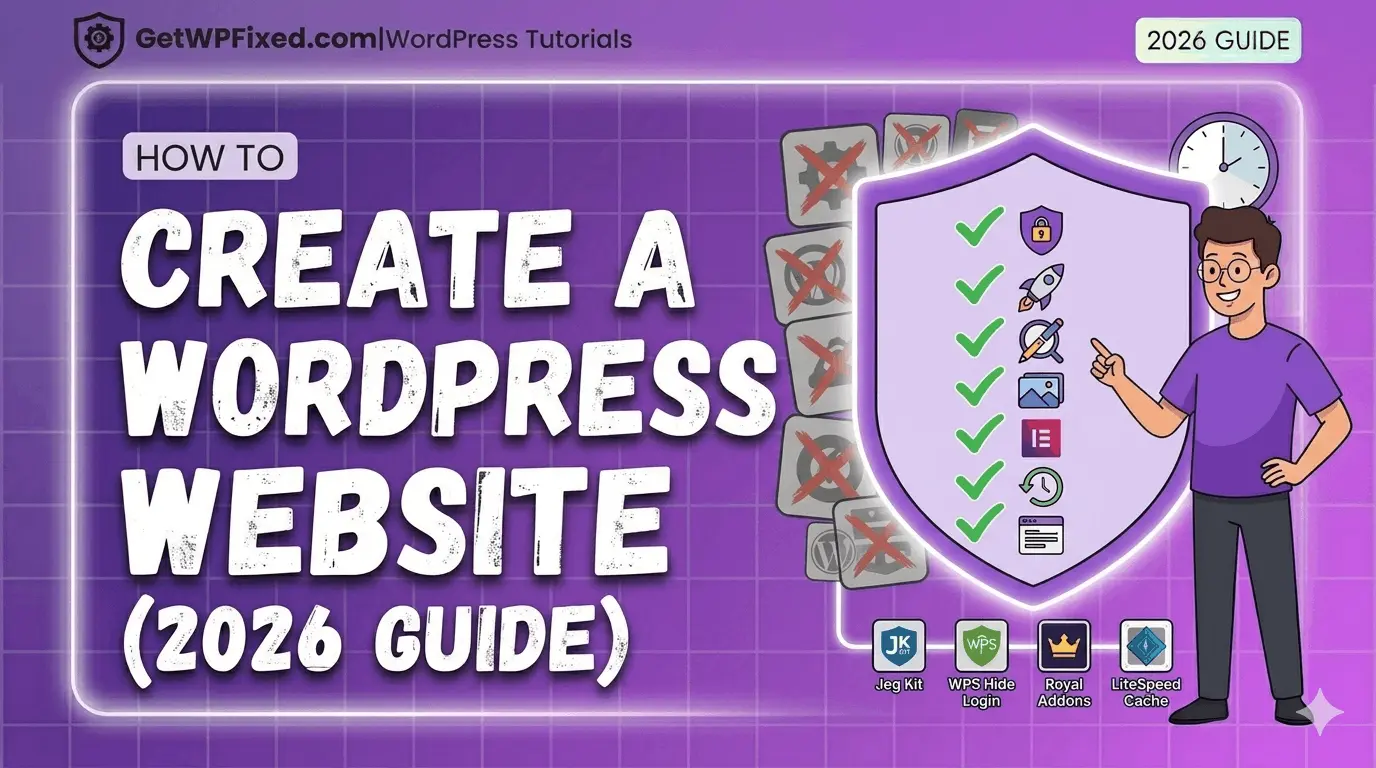
If you want to create a professional WordPress website in 2026 without spending thousands of dollars, you are in the right place. Welcome to the ultimate guide where I, Dattatraya, will show you how to build your dream site from scratch. The good news? In 2026, you do not need to be a coding genius or have a $5,000 budget. You just need a plan. At GetWPFixed, I am all about simplifying the complex. I’ve seen thousands of people start their sites, and I know exactly where they get stuck. Forget the “get-rich-quick” tutorials. This is a real, human, honest roadmap. By the end of this guide, you will know exactly how to create a professional WordPress website that is fast, secure, and ready to dominate your niche. Let’s get you fixed! The “Dattatraya Philosophy”: Free but Pro Before we start, I need to tell you my one rule for this guide: We will utilize powerful FREE tools to get a premium result. Many “experts” in 2026 will tell you that you must buy Elementor Pro, a premium theme, and five different “Pro” addons to get a high-quality site. That is incorrect. My 10-step method will show you how to use a standard theme like Hello Elementor, powerful free addons like Royal Elementor Addons, and advanced free designers like Jeg Elementor Kit to build a site that looks like it cost thousands of dollars. Here is your 10-step roadmap to creation. Part 1: The Invisible Foundation (Hosting & Install) Step 1: Secure your Domain & Hosting (Your 2026 Check) Think of your Domain (e.g., getwpfixed.com) as your street address, and Hosting as the actual physical house. You must own your domain, and your hosting is the most critical technical choice you will make. In 2026, do not accept cheap, outdated hosting from a “big name” host. Technology has moved on. If your host doesn’t offer this specific 2026 checklist, move on: These specs are the foundation for a fast site. Remember our core principle: optimizing performance is the key to having a successful site, and it all starts here, just like I discussed in my how to fix a slow Elementor website guide. Step 2: Install WordPress (The One-Click Way) Almost every modern host offers a “One-Click WordPress Install” or an “Auto-Installer.” It usually looks like a large blue button in your hosting control panel. Use it. Step 3: Cleanup and Basic Settings When you log in for the first time (yourdomain.com/wp-admin), you will see some sample content. Be ruthless: Finally, go to Settings > Permalinks. Change this setting to “Post Name.” This ensures your URL looks like mysite.com/about instead of mysite.com/?p=123. It’s cleaner for users and critical for SEO. Part 2: Design & Content (The Vision) Step 4: Choose a “Speed-First” Theme Choosing the right theme is the first major decision you make when you create a professional WordPress website. Elementor is your “designer,” not your theme. You need a simple “blank canvas.” For this guide, I highly recommend installing the free Hello Elementor theme. It is a “minimalist shell” designed specifically to let Elementor do the work, without adding extra code that can slow your site down—a critical choice if you want to fix slow Elementor website issues later. Step 5: Using Elementor and Jeg Kit to Create a Professional WordPress Website This is where the magic happens. We need our design team: Why Jeg Kit? This is my “pro hack” for 2026. The free version of Elementor locks you out of designing your site’s header and footer. Jeg Elementor Kit unlocks these exact “Pro” features for free. It lets you create custom headers, footers, and archive pages, and includes dozens of stunning, pre-made template kits that you can import with a single click. Part 3: The Technical Standard (Security & Speed) Step 6: Install the Essential Must-Have Plugins You are ready to activate the tools that will power your site. This is a common point where beginners overload their sites, so we will be minimalist. Refer back to my list of 7 essential must have plugins for a complete guide. For this creation roadmap, ensure you install these three immediately: Step 7: Finalize Performance Optimization A slow site will fail, regardless of how good it looks. With LiteSpeed activated, go to Elementor > Settings > Performance and enable the native experimental features for improved asset loading. Also, ensure you have a plugin like Converter for Media installed to serve efficient WebP images. These are the steps I detailed to fix slow Elementor website performance, and they are not optional in 2026! Step 8: Complete Foundational Security Your site is now a target. We must harden the defenses. Remember what we learned about securing your entrance? Part 4: Building the Framework (The Pages) Step 9: Create Your “Core” Pages Your site needs structure. Go to Pages > Add New and create five pages with these standard titles (we won’t design them yet, just create the structure): Crucial Link: Go to Settings > Reading. Change “Your homepage displays” to “A static page.” Select your newly created “Homepage” for the homepage and “Blog” for the posts page. Now that your pages are ready, you can see how easy it is to create a professional WordPress website using free tools. Step 10: Launch Your First Post & Submit Your Sitemap Go to Posts > Add New and write your very first blog post! Tell your audience what your site is about and what they can expect. Share your passion, but remember that security is key, even when launching content. If you’ve been working on routine maintenance and see an error, don’t panic! Check out my guide if your WordPress is stuck in maintenance mode to get back online in minutes. Once your post is published, go to your Rank Math SEO settings, find the Sitemap settings, and copy your Sitemap URL (usually sitemap_index.xml). You must submit this URL to your Google Search Console account so Google can officially index your … Read more