WordPress Stuck in Maintenance Mode? (Don’t Panic, Here’s the 2-Minute Fix)
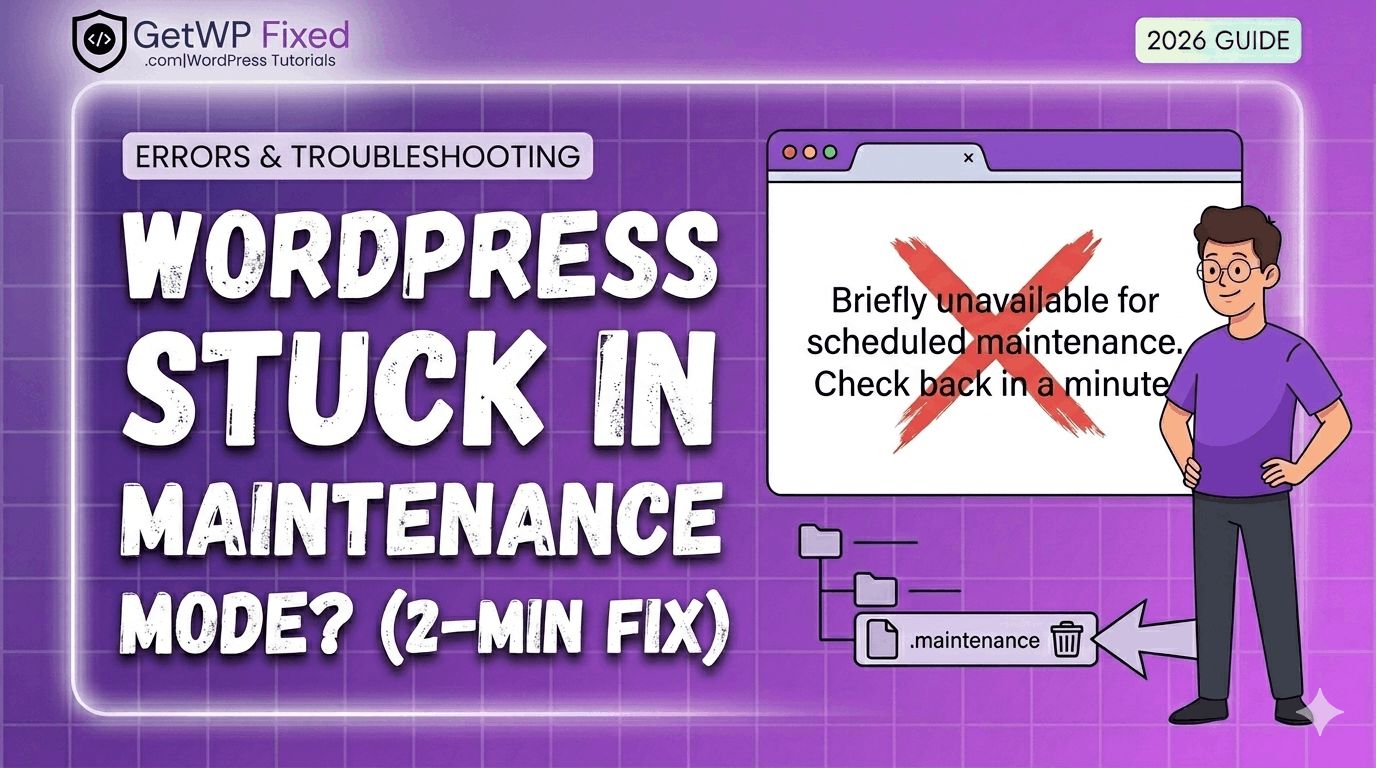
We’ve all been there. It’s 10:00 PM, you’re just finishing up some routine site maintenance, and you see that red “Update” bubble on a plugin. You think, “I’ll just click this quickly before I log off.” You click Update. Your screen refreshes. And suddenly, your entire website—your beautifully designed homepage, your valuable blog posts, your online store—is gone. It’s replaced by a single, terrifying line of plain, white text on a blank screen: “Briefly unavailable for scheduled maintenance. Check back in a minute.” Ten minutes go by. You check back. It’s still there. You try your admin dashboard. It’s blocked, too. Panic starts to set in. At GetWPFixed, I see this issue almost every week. If this is happening to you right now, the first thing I want you to do is take a deep breath. I promise you didn’t break your website. Your data is safe. This isn’t a hack, and it’s not a server crash. It’s just a tiny, stubborn “ghost” file that didn’t delete itself correctly. This is my definitive 2026 guide to resolving this error. By the end of this post, you will understand exactly why this happens, how to fix it in two minutes (most of the time), and how to prevent it from ever happening again. Let’s get your site back online. Part 1: Why Does WordPress Get Stuck in Maintenance Mode? (The Science Behind the Error) To fix the problem permanently, it helps to understand what’s happening behind the scenes. This error is actually a feature, not a bug. 1.1 The Maintenance Mode Process When you click the update button for a core WordPress file, a theme, or a plugin, WordPress needs a “safe space” to make those changes. It can’t have live users navigating the database while it’s trying to rewrite its core files. Here is the four-step “Handshake” process that should happen: 1.2 The Failure: What Went Wrong? The problem occurs when Step 3 finishes but Step 4 fails. The update completes, but the handshake gets “confused,” and the .maintenance file is never deleted. Your site remains locked, still displaying the “DO NOT DISTURB” sign. The most common reasons for this failure are: Now that we know why we are stuck, let’s fix it. Part 2: The Easiest Fix (Try This First) Before we start messing with files and code, try the simplest “non-techy” solutions. There is a 90% chance one of these two steps will fix it instantly. Fix #1: Force Refresh (The Hard Refresh) Sometimes, your site is actually already fixed, but your browser is still showing you a “cached” version of the error. A standard refresh won’t work. You need to tell your browser: “Forget everything you think you know about this URL, and load a fresh version from the server.” This is called a “Hard Refresh” or “Clear Cache for this Page.” Fix #2: Clear Your Browser Cache and Cookies If the hard refresh didn’t work, your browser might be stubbornly clinging to the memory of that error page in its cookies. Try opening your site in an Incognito or Private window. If it loads there, you are fixed! Just clear your browser cache and cookies, and your standard window will work again. Part 3: The Technical Fix (Deleting the Stubborn File) If you have tried the “easy fixes” and your site is still showing the maintenance message, you have to get your hands dirty. We need to manually delete that .maintenance file. Don’t panic—this is as scary as it sounds. You just need access to your site’s root directory (the core “filing cabinet” of your WordPress install). What You Will Need There are two ways to do this. I will show you both. Method A: Using CPanel’s File Manager (Easiest Method) If your host uses CPanel (common with hosts like Bluehost, SiteGround, and many others), this is the fastest way to fix the problem. What If I Don’t See the .maintenanceFile? This is a common frustration. In some File Managers, “hidden” files are disabled by default. If you are in the public_html folder and don’t see the file, look for a “Settings” or “Preferences” cog icon (usually in the top-right corner). Click it, and check the box that says “Show Hidden Files (dotfiles).” The .maintenance file should now appear. Method B: Using an FTP Client (The Developer Way) If you don’t use CPanel or prefer to use an FTP client, you can follow these steps. For this example, I am using FileZilla (which is free and safe). Part 4: Advanced Troubleshooting (What If Method A and B Failed?) So, you’ve deleted the .maintenance file, you’ve cleared your cache, and your site is still stuck. This is a much rarer scenario, but it happens. If deleting the file didn’t work, it means that the problem wasn’t the .maintenance file at all—it means your server is physically stuck in the middle of a conflict and doesn’t know how to stop. Here is what you need to do next, in order of likelihood: 4.1 Check Your PHP Memory Limit A very common reason an update fails in 2026 is that the update itself required more temporary “brainpower” (memory) than your host allows. If your site hit its limit, the update process stopped, but the maintenance signal got stuck. You can increase this limit easily by adding a line to your wp-config.php file (the same place you found that .maintenance file!). Open wp-config.php and paste this line just before the text that says “That’s all, stop editing! Happy publishing.”: define(‘WP_MEMORY_LIMIT’, ‘512M’); We have a dedicated [post on fixing memory limit errors] if you need more help with this! Increasing the memory often “nudges” the server to complete the pending processes. 4.2 Manually Deactivate Your Plugins If increasing the memory didn’t work, we must assume that one of your plugins (the one you just tried to update, or another one) is in an active conflict. Since you can’t access your admin dashboard to disable them, we have to do it … Read more